Unsolicited redesign of the personal insurance section​

Role

UX/UI Designer

Team

UX Researcher and me

Tools

Figma, Photoshop, Illustrator

Overview

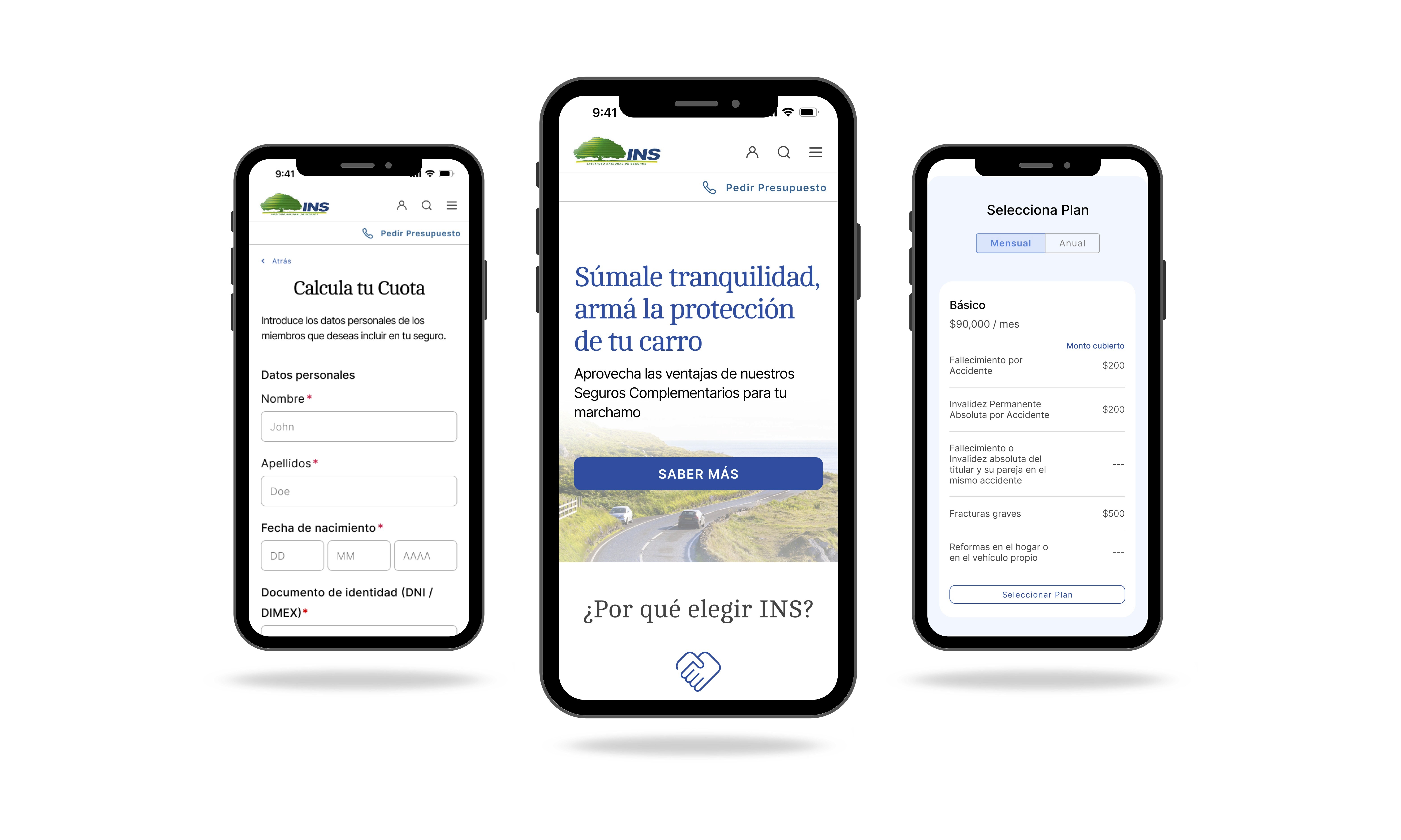
The National Insurance Institute (INS) is Costa Rica’s sole public insurance provider, but its digital platform lacked clarity, structure, and mobile responsiveness. I independently took on the challenge of redesigning the ‘Personal Cover Insurance’ flow—simplifying the interface, reorganizing content, and modernizing the mobile experience to better support users making important financial decisions.

Problem

  • Complex navigation and poor mobile responsiveness caused users to drop off before completing key tasks.

  • Users struggled to understand the insurance products, due to dense content and unclear labeling.

  • Information was hard to access, especially on smaller screens, increasing frustration and task abandonment.

These challenges pointed to a clear need for interface simplification and mobile-first optimization to reduce friction and improve clarity.

Outcome

  • Reduced cognitive load on the homepage by decluttering content and improving layout hierarchy.

  • In usability tests, simulated drop-off rates decreased from 77% to 15%, indicating a more intuitive and engaging flow.

  • Improved information discoverability, allowing users to quickly find and understand insurance options—particularly on mobile.
Discovery Phase

I began by reviewing the existing platform through a heuristic evaluation, identifying major usability violations such as inconsistent terminology, unclear CTAs, and overloaded pages. I also benchmarked public insurance sites in Latin America and Europe to gather best practices for structure and readability. This helped shape a direction grounded in clarity, mobile optimization, and user empowerment.

Key Insights

I quickly realized users’ drop-off points by collecting data, conducting research about INS’ user behavior, and studying other insurance companies. These insights helped me determine how to approach MVP solutions.

  • 77% drop off the INS website during the search process because of “complex navigation”.

  • 25% struggle to find helpful information on the site.

  • 50% do not perceive the full range of insurance products clearly and straightforwardly.

  • 92% tried to access the website via mobile and it appeared not to be responsive.

Goal

My objective was to redesign the ‘Personal Cover Insurance’ flow into a responsive, user-first experience by addressing three core challenges: lack of clarity, poor mobile access, and overwhelming information. The solution aimed to guide users through key decisions with confidence and ease.

Solution

1. Simplified Navigation with User-Centered Structure

I reorganized the navigation based on user goals rather than internal categories, reducing confusion and cognitive load.

  • Replaced technical insurance jargon with task-based labels

  • Designed a top-level structure that guides users instead of overwhelming them

  • Added a visible, mobile-friendly search bar to reduce time to action

3. Responsive, Mobile-Optimized Purchase Flow

Users can now complete the entire quoting and purchase journey on any device, with fewer steps and clearer input guidance.

  • Redesigned quote and form flows for mobile-first use

  • Reduced fields and errors with better visual hierarchy

  • No need to zoom or scroll awkwardly on small screens

2. Clear, Visual Product Cards for Easier Comparison

Insurance options were previously hidden behind dense text. I introduced modular product cards with key info at a glance.

  • Highlighted the essential details: coverage, price, and who it’s for

  • Used visual hierarchy, icons, and spacing to reduce reading fatigue

Usability Testing

I conducted a remote, moderated usability test using a ‘think out loud’ approach. Five participants completed two key tasks based on real user journeys:

  1. Search for information about Life Insurance.

  2. Fill out a form and request a quote.

Key findings:

  • 85% of users preferred completing the process online rather than by phone, confirming a need for clear self-service options.

  • Form error rates dropped by 40% in the new design, thanks to improved input hierarchy and field clarity.

  • Users described the redesigned interface as “much clearer” and easier to navigate, especially when comparing insurance options.

Outcome

  • Reduced cognitive load on the homepage by decluttering content and improving layout hierarchy.

  • In usability tests, simulated drop-off rates decreased from 77% to 15%, indicating a more intuitive and engaging flow.

  • Improved information discoverability, allowing users to quickly find and understand insurance options—particularly on mobile.
Next Steps

  • Expand user research by diversifying user demographics to understand different needs.

  • Implement A/B testing to test new functionalities and evaluate their effectiveness and user reception.

  • Improve features to make the app more accessible to all users.

  • Ensure a seamless experience across different devices.

Latest projects

Other projects

Some of my
other stuff

Create a free website with Framer, the website builder loved by startups, designers and agencies.